
 Home
Home
Share this article on


June 16, 2026
Training
Building Digital Competences in Libraries: How DigComp Supports the DigLib Curriculum
Public libraries are changing. They are no longer only places to borrow books or search for information. Today, they are also spaces where people learn, connect, and explore the digital world with more confidence. This role is especially important for people who need extra guidance, such as seniors, migrants, unemployed adults, or citizens who rarely use digital tools in their daily lives.
This is one of the core ideas behind DigLib. The project supports public libraries in becoming inclusive digital learning hubs, where librarians act as guides and community facilitators. To do this effectively, librarians need strong digital competences themselves, and the confidence and methods to support others.
A curriculum built on European foundations
Within DigLib, EOS Foundation coordinated the development of the curriculum and learning materials. A key decision was to ground the training programme in two recognised European frameworks: DigComp and DigCompEdu. These gave the curriculum a clear, structured, and practical foundation that responds to the real needs of both librarians and library users.
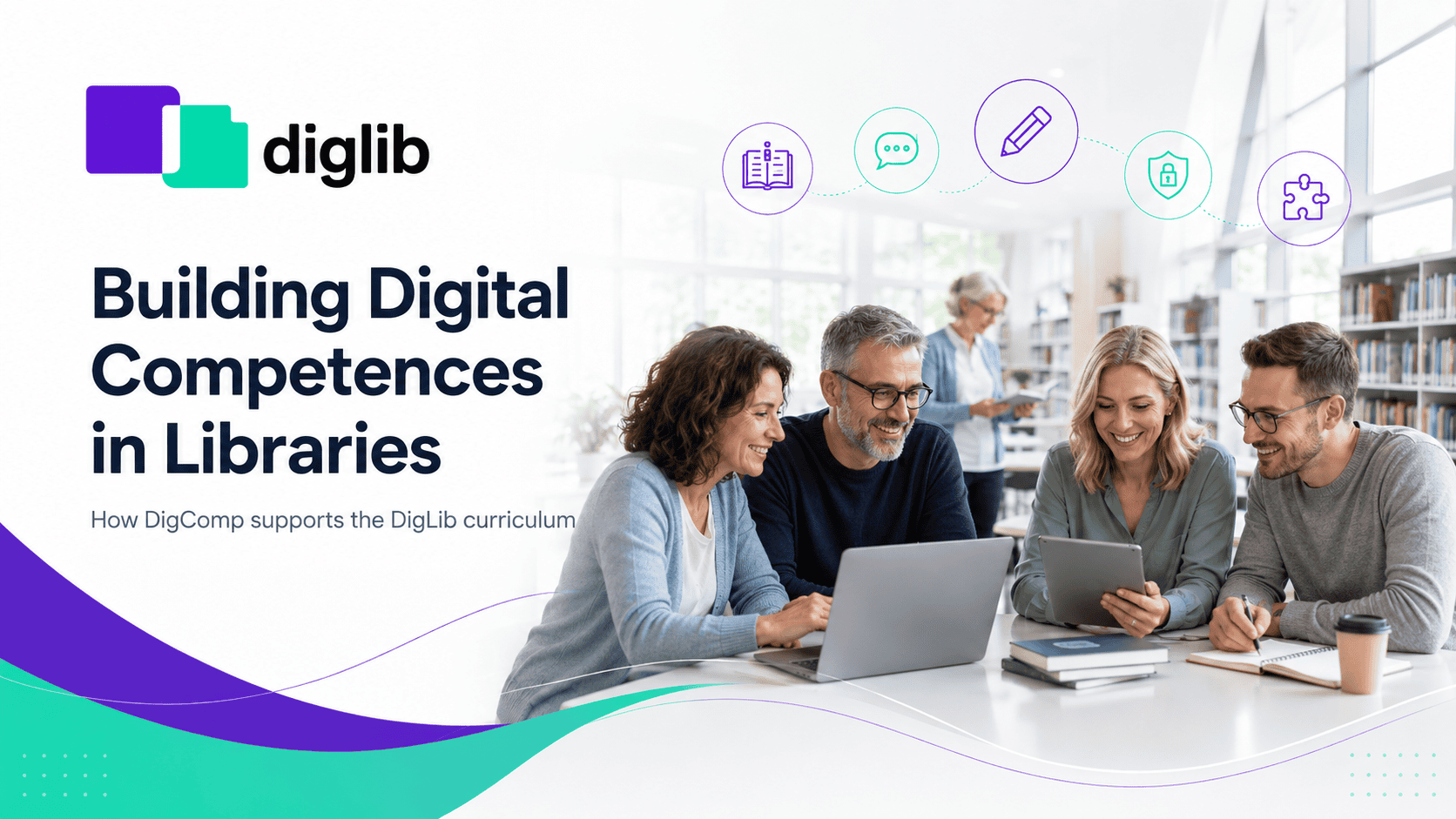
DigComp, the European Digital Competence Framework for citizens, forms the basis of the first part of the curriculum, focused on digital competences for adult learners, including both librarians and library users. It covers five main areas: information and data literacy, communication and collaboration, digital content creation, safety and security, and problem solving. Each area was adapted to the library context and connected to topics that are highly relevant today, such as generative AI, media literacy, misinformation, privacy, cybersecurity, and digital identity.
Rather than simply teaching people how to use digital tools, the curriculum focuses on helping learners understand, evaluate, create, communicate, and problem-solve in digital environments. For example, the module on information literacy explores how to search, evaluate sources, and understand how data is collected, including by AI systems. The module on safety covers online risks, scams, digital well-being, and how to protect personal data. The problem-solving module encourages learners to keep learning as technology evolves, including emerging tools like AI, VR, and the Internet of Things.
Supporting librarians as facilitators
The second part of the curriculum is based on DigCompEdu, the European framework for educators' digital competences and is designed especially for librarians. While they may not always see themselves as teachers, they support learning every day: explaining digital services, organising workshops, guiding users, and helping people become more independent online.
This part of the training focuses on librarians as community facilitators. It covers topics such as designing learning activities, selecting and adapting digital resources, supporting inclusive learning, and planning Library Living Labs - the community-based digital education programmes at the heart of the DigLib project.
Flexible, people-centred, and built for communities
The DigLib curriculum is modular and adaptable to different groups, local needs, and levels of digital experience. A library working with seniors might focus on safety and basic digital services. One supporting job seekers might prioritise digital identity and online collaboration. One engaging young people might lean into media literacy, content creation, or AI tools.
Throughout, the focus is on people. In a rapidly changing digital society, competences such as critical thinking, responsible use of technology, online safety, collaboration, and creativity are no longer optional. They are part of everyday life. Through the DigLib curriculum, libraries can become places where these competences are developed in an accessible, friendly, and community-based way.